











A Second Set of Eyes That Fits in Your Pocket: SonoMaxx MX9 Pro with AI‑Powered Cartilage Analysis for Orthopedics and Sports Medicine
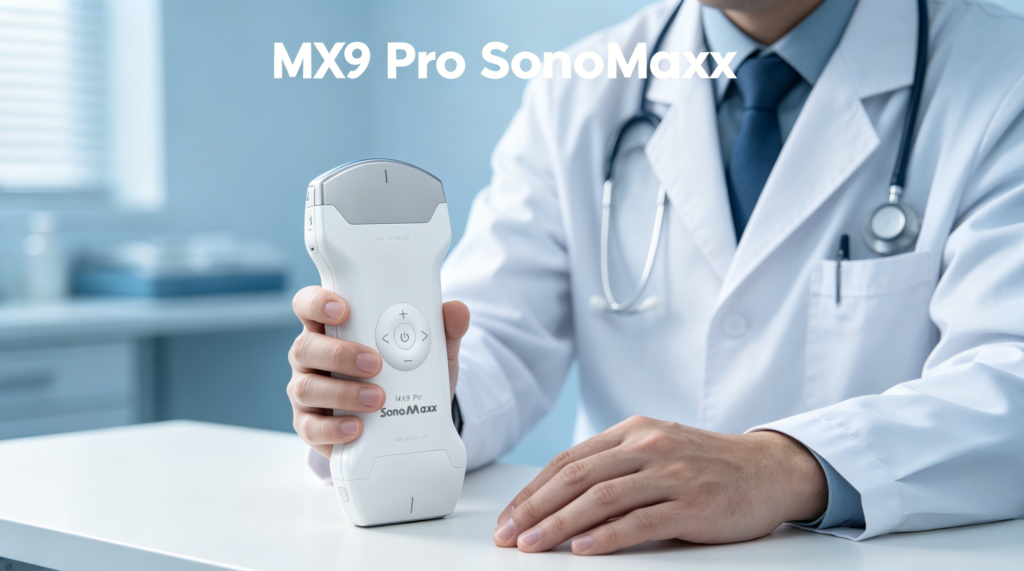
VANCOUVER, Canada – For orthopedic surgeons, sports medicine physicians, and rehabilitation specialists, cartilage assessment has long been a nuanced skill—relying on experience and subjective judgment. A new peer‑reviewed study published in Ultrasound in Medicine & Biology demonstrates that AI can now match human‑level performance in knee cartilage segmentation when deployed on handheld ultrasound devices like the SonoMaxx MX9 Pro.
Clinically Validated Agreement
The study evaluated MonoUNet, a compact AI model designed specifically for point‑of‑care ultrasound (POCUS) devices. When comparing MonoUNet’s automated cartilage measurements against manual clinician readings, the results showed:
Cartilage thickness: ICC₂,k = 0.96 (bias = 2.00% / 0.047 mm)
Echo intensity: ICC₂,k = 0.99 (bias = 0.80% / 0.328 a.u.)
An intraclass correlation coefficient (ICC) above 0.90 is generally interpreted as “excellent reliability.” Both metrics comfortably exceed this threshold, confirming that clinicians can trust the AI’s outputs with confidence comparable to manual expert assessment.
The MX9 Pro Advantage
The SonoMaxx MX9 Pro transforms this validated AI from a research paper into a practical, everyday clinical tool:
True portability: At just 250 grams, the MX9 Pro fits in a white coat pocket.
Wireless freedom: No cables, no cumbersome cart—just pick it up and scan.
3‑in‑1 probe versatility: Linear, convex, and phased array in a single device, covering everything from superficial MSK to cardiac and abdominal exams.
For orthopedic clinics and sports medicine practices, this means being able to perform AI‑guided cartilage assessments right in the exam room—no referrals to radiology, no waiting for reports.