









Foreign body detection is one of the most practical applications of POCUS in daily clinical practice.
Foreign bodies embedded in soft tissue are not always easy to identify on physical examination alone, especially when the entry wound is small or when patients present later after injury. Wood splinters, glass fragments, metal particles, plastic, and organic materials may remain hidden beneath the skin and lead to pain, inflammation, abscess formation, or persistent infection.
POCUS enables rapid bedside assessment and improves diagnostic confidence in real time. On ultrasound, foreign bodies often appear as hyperechoic structures with posterior acoustic shadowing, reverberation artifacts, or surrounding inflammatory changes. Dynamic scanning in multiple planes improves localization and may assist with guided removal.
One of the greatest advantages of handheld ultrasound systems is accessibility. Carrying a portable POCUS device directly into the clinic, emergency department, or community setting can significantly shorten the time between suspicion and diagnosis.
At SonoMaxx, we believe that ultrasound accessibility must be combined with practical education, hands-on training, and continuous professional support. A portable device alone is not enough. Clinicians also need the skills and confidence to integrate POCUS into real clinical decision-making.
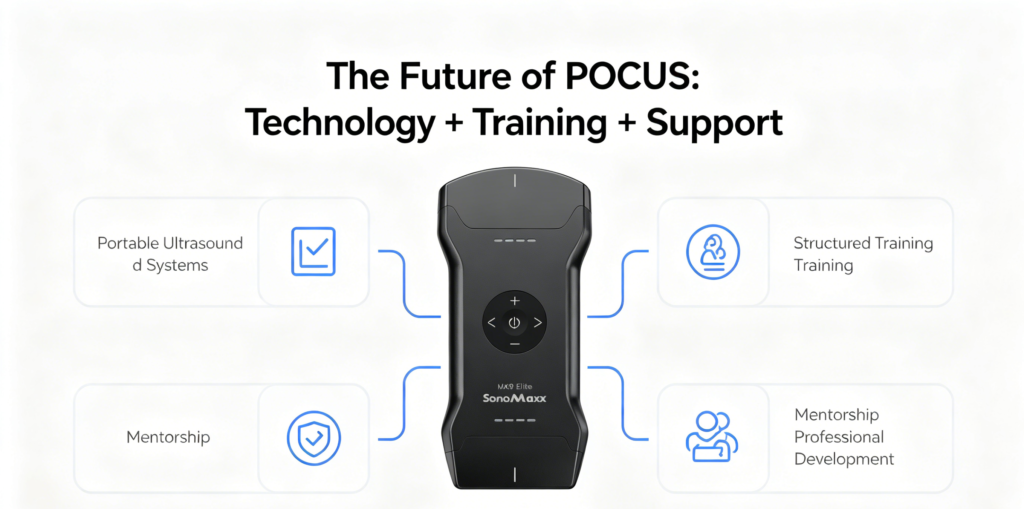
The future of POCUS is not only about technology. It is about building a complete learning ecosystem that combines portable ultrasound systems, structured training, mentorship, and ongoing professional development.
Early identification of foreign bodies with POCUS can improve patient care, reduce unnecessary imaging, and support faster bedside management.